

The short answer: almost every big chip company in the world has a large design centre in India, mostly in Bengaluru, Hyderabad, Noida and Chennai. Add the EDA companies, a strong design services industry and a growing set of Indian chip startups, and you have hundreds of places that hire VLSI engineers. The trick is knowing which kind of company suits the start you want.
The old version of this page was a very long list. Lists are useful, but they don’t help you decide where to apply. So I’ve grouped the companies by type, explained what working at each type is like, and kept the lists short and scannable. The names below are well-known examples, not a complete list.
- The six kinds of VLSI employers
- Chip product companies
- EDA and IP companies
- Design service companies
- Indian chip startups
- Fabs, OSAT and equipment makers
- Where I’d start, depending on your goal
Table of Contents
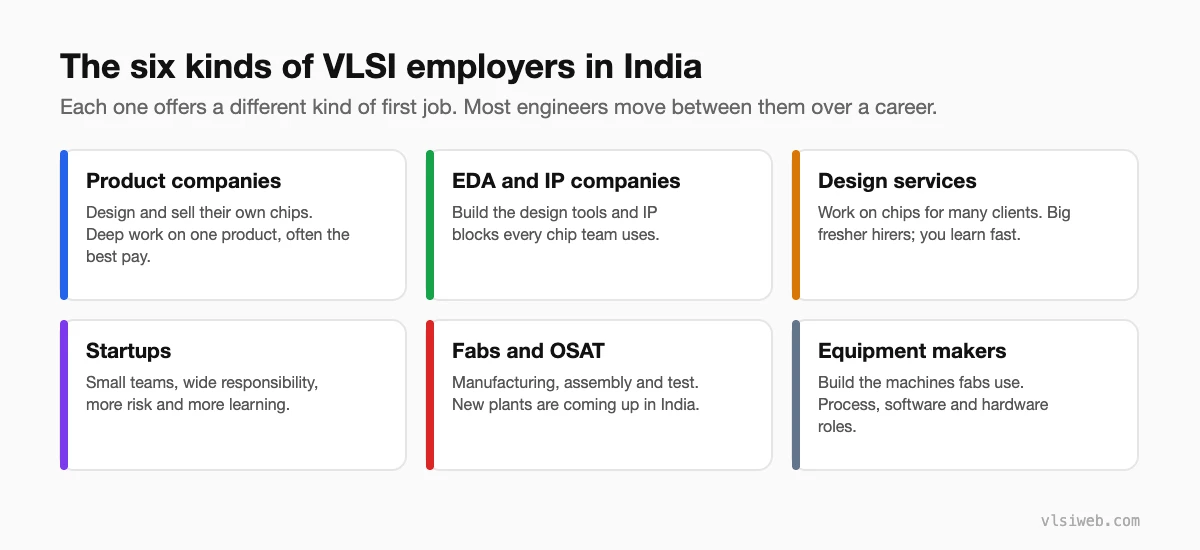
Part 1: The six kinds of VLSI employers
Part 2: Chip product companies
These companies design and sell their own chips, and many of their biggest design teams outside the US are in India. You usually work deeply on one product, often all the way to silicon. Pay is generally the highest, and so is the bar to get in.
| Company | What they mainly do |
|---|---|
| Intel | CPUs, SoCs and platform design |
| Qualcomm | Mobile, automotive and connectivity SoCs |
| NVIDIA | GPUs and AI accelerators |
| AMD | CPUs, GPUs and adaptive computing (FPGAs, after Xilinx) |
| Texas Instruments | Analog, power and embedded processors |
| Broadcom | Networking, storage and broadband chips |
| Marvell | Data infrastructure, networking and custom silicon |
| Micron | Memory and storage |
| Samsung Semiconductor India Research | Memory, SoC and foundry-related design |
| Analog Devices | Analog, mixed-signal and power |
| NXP, Infineon, STMicroelectronics, Renesas | Automotive, industrial and microcontrollers |
| MediaTek | Mobile, connectivity and smart-device SoCs |
| Microchip | Microcontrollers, FPGAs and mixed-signal |
Part 3: EDA and IP companies
EDA companies build the tools every chip team uses, and IP companies sell ready-made blocks like CPU cores and interfaces. Roles include R&D (writing the tools), application engineering (helping customers use them) and IP design and verification. If you like both hardware and software, this is a great fit.
| Company | What they mainly do |
|---|---|
| Synopsys | EDA tools, IP, and simulation (including the former Ansys) |
| Cadence | EDA tools, IP and system analysis |
| Siemens EDA | Verification, DFT, physical verification tools |
| Arm | CPU and system IP |
| Rambus | Memory interface and security IP |
| Keysight | EDA for RF and high-speed design, plus test equipment |
Part 4: Design service companies
Service companies do chip design, verification and physical design work for many clients. They hire freshers in large numbers, and you get to see many projects, tools and flows quickly. It’s one of the most common first jobs in VLSI, and a very good one if you use it to learn.
| Company | What they mainly do |
|---|---|
| HCLTech | Large semiconductor engineering services practice (including the former Sankalp Semiconductor) |
| Wipro | VLSI design, verification and embedded services |
| L&T Technology Services | Semiconductor and embedded engineering services |
| Tata Elxsi | Embedded and design services |
| eInfochips (an Arrow company) | ASIC, FPGA and embedded services |
| Tessolve | Post-silicon test, validation and design services |
| MosChip | ASIC design and IP services |
| Capgemini Engineering | Semiconductor engineering services |
| Cyient, Mirafra, ACL Digital | Design and verification services |
Part 5: Indian chip startups
India’s chip startup scene has grown a lot, helped by government programmes like MeitY’s Design Linked Incentive scheme. Startups give you wide responsibility early. They also carry more risk, so check funding and the team before you join. A few names worth following:
- Mindgrove Technologies: RISC-V based SoCs
- InCore Semiconductors: RISC-V processor cores
- Netrasemi: edge AI and vision SoCs
- Saankhya Labs (now part of Tejas Networks): communication and broadcast chips
New startups appear every year, so follow industry news and LinkedIn rather than relying on any fixed list, including this one.
Part 6: Fabs, OSAT and equipment makers
India has historically done chip design, not manufacturing. That’s starting to change, with fab and assembly projects under the India Semiconductor Mission, including Tata Electronics’ fab and assembly plans and Micron’s assembly and test facility in Gujarat. These create process, manufacturing, test and equipment roles that barely existed in India a few years ago.
Equipment companies such as Applied Materials, Lam Research and KLA also have large engineering teams in India, working on software, hardware and process for the machines that fabs use.
Part 7: Where I’d start, depending on your goal
- Want to learn fast across many projects? A design service company.
- Want to go deep on one chip and see it to silicon? A product company.
- Like software as much as hardware? An EDA company.
- Want wide responsibility early and can handle risk? A funded startup.
- Interested in how chips are made? Fab, OSAT and equipment roles.
Whatever you choose first, it’s not permanent. Plenty of engineers start in services, move to a product company, and some later join or found startups. For how to actually find openings at these companies, see where to find VLSI jobs.
Practise this on VLSI Forge
I built VLSI Forge so you can write RTL in your browser, run it on a real simulator and check every signal in the waveform. Free, nothing to install.
FAQ
Which city has the most VLSI jobs in India?
Bengaluru, by a clear margin, followed by Hyderabad. Noida, Chennai, Pune and Ahmedabad also have growing semiconductor teams.
Are service companies a bad first job?
No. They’re one of the best places to learn quickly, because you see many projects and flows. Use the first two to four years to build real skills and ownership, then decide your next step.
Do these companies hire freshers?
Most of them do, through campus placements, graduate programmes and fresher hiring drives. Service companies hire freshers in the largest numbers.
Is this list complete?
No, and no list can be. Companies open, merge and change focus every year. Use this as a map of the types of employers, and check each company’s own career page for current openings.
