

The short answer: a digital design engineer, often called an RTL design engineer, turns a chip specification into working hardware described in Verilog or SystemVerilog. The job is part architecture, part coding and part debugging: you decide how a block should work, write synthesisable RTL for it, and make sure it meets timing, power and area goals.
Of all the VLSI roles, this is the one most people picture when they think of “chip design”. It is a great role if you enjoy building things and seeing them work. In this guide I will explain what the work is really like, beyond the job description.
- What a digital design engineer actually does
- A typical week
- The skills you need
- Tools you will use
- How I would get started
- Where the role leads
Table of Contents
Part 1: What a digital design engineer actually does
Design engineers own the logic of a block, for example a DMA controller, a cache, a bus interface or a piece of an AI accelerator. You start from a specification, plan the micro-architecture (pipelines, FSMs, interfaces, memories), write the RTL, and keep it healthy all the way to tape-out.
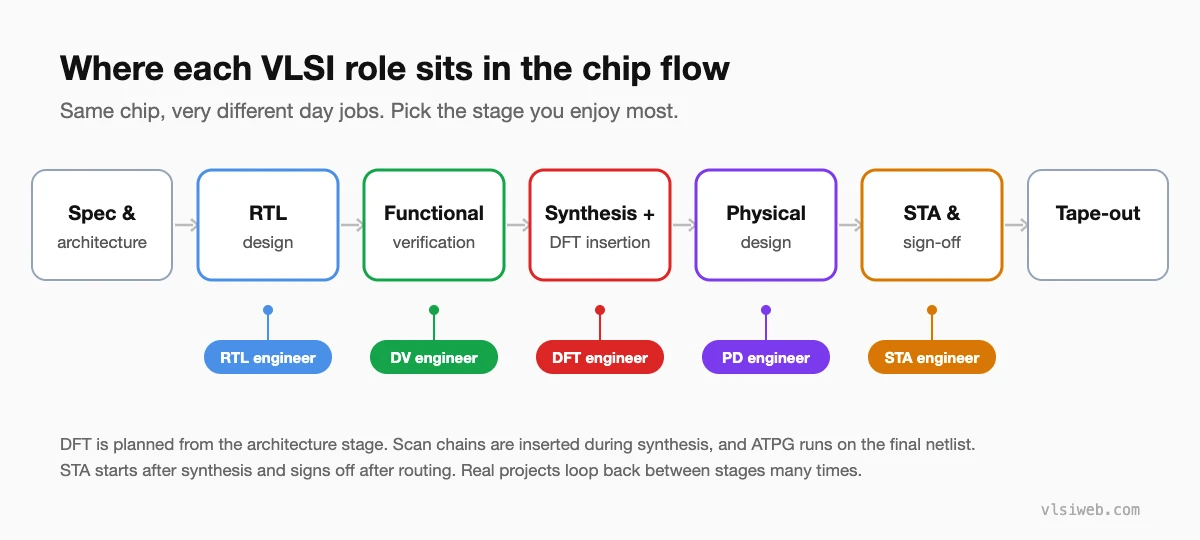
You do not work alone. Verification engineers test your block, synthesis and STA engineers tell you about timing problems, physical design engineers tell you about congestion, and DFT engineers add test logic. A big part of the job is responding to all of them quickly and cleanly.
Part 2: A typical week
Every week is different, but most look something like this:
- Reading and clarifying a spec, and writing a short micro-architecture document
- Writing or changing RTL for a feature
- Debugging failing tests with the verification team, usually in a waveform viewer
- Cleaning up lint and CDC reports
- Fixing a long timing path flagged after synthesis
- Design reviews: presenting your block and reviewing other people’s
Part 3: The skills you need
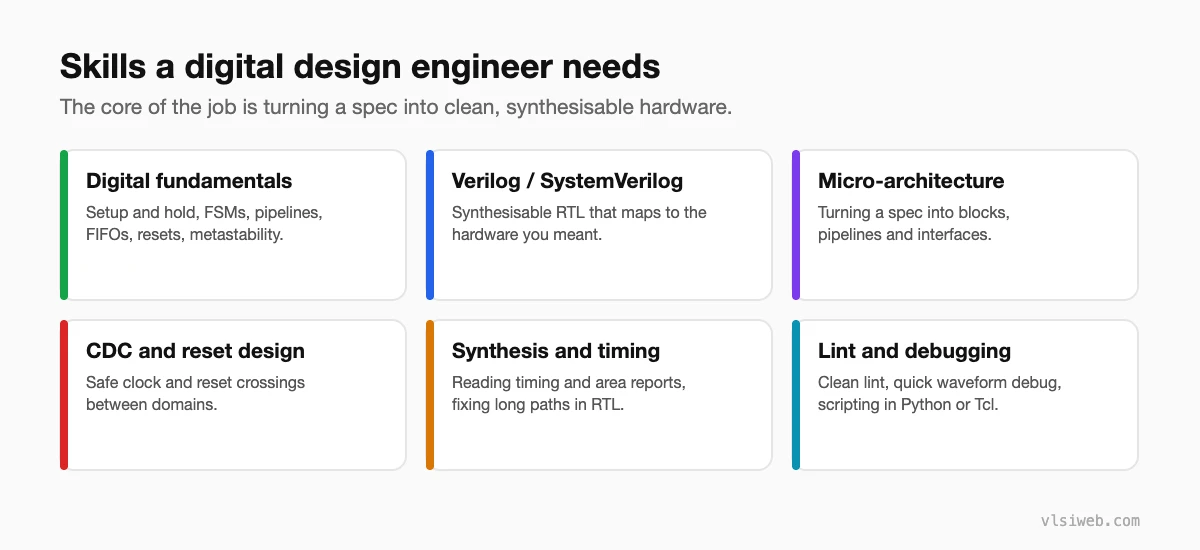
If I had to pick one skill that separates strong designers, it is micro-architecture: knowing how to break a problem into pipelines, FSMs and buffers before you write a single line of code. Good RTL follows naturally from a good plan.
The second is knowing what your code turns into. A missing default in a case statement becomes a latch. A long chain of logic between two flops becomes a timing violation. Good designers think in hardware, not in software.
Part 4: Tools you will use
You will use a simulator (VCS, Xcelium or Questa at work; Verilator or Icarus at home), a waveform viewer, a lint and CDC checker (for example SpyGlass or similar tools), and a synthesis tool to check timing and area early. Git, Make and Python or Tcl scripts hold it all together.
Part 5: How I would get started
- Get solid on digital fundamentals: FSMs, setup and hold, FIFOs, CDC basics.
- Write small synthesisable designs every day: counters, muxes, shift registers, FSMs, FIFOs.
- Build one bigger project, such as a UART, an AXI-Lite slave or a small pipelined CPU, with a testbench.
- Run your designs through an open-source synthesis tool like Yosys to see what hardware your code becomes.
- Practise interview-style RTL problems until you can write them without notes.
Practise this on VLSI Forge
I built VLSI Forge so you can write RTL in your browser, run it on a real simulator and check every signal in the waveform. Free, nothing to install.
RTL Design problems · CDC and RDC problems · Build a RISC-V CPU
Part 6: Where the role leads
A typical path goes from owning features, to owning blocks, to owning a subsystem as a lead designer. From there, many designers move into micro-architecture or chip architecture, where you decide how the whole chip should work. Others move into management.
Design is also a good base for switching later: designers who understand timing do well in STA, and designers who like breaking things often make excellent verification engineers.
FAQ
Is RTL design harder to get into than verification?
Usually, yes. Most projects need more verification engineers than designers, so there are fewer design openings for freshers. Strong fundamentals and a good design project help a lot.
Do I need to know verification as a designer?
You need to write basic testbenches and debug failing tests. You do not need to be a UVM expert, but understanding how your block is verified makes you a much better designer.
Which language should I learn, Verilog or SystemVerilog?
Start with Verilog, then move to the synthesisable parts of SystemVerilog. Most teams write RTL in SystemVerilog today.
Is VHDL still used?
Yes, mainly in FPGA, defence and some European companies. Verilog and SystemVerilog are far more common in ASIC design.
