

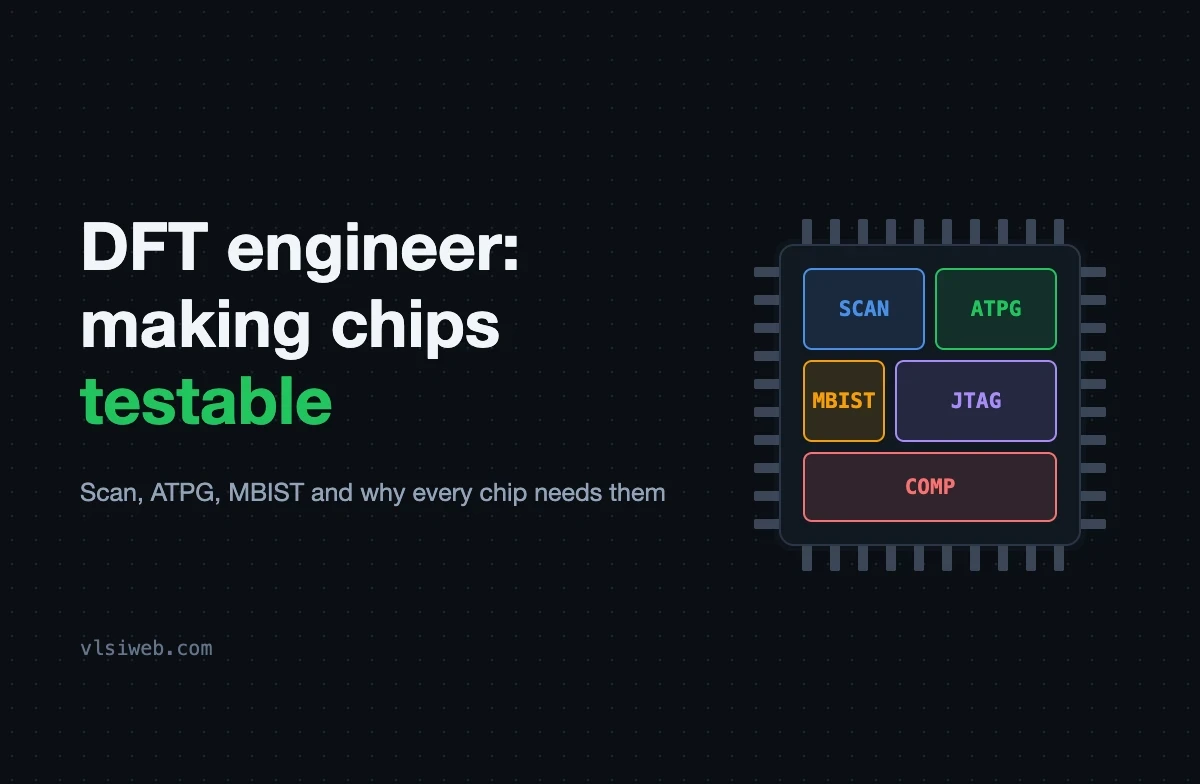
The short answer: a DFT (design for testability) engineer adds test logic to a chip so that every manufactured part can be tested for defects quickly and cheaply. That means scan chains, test compression, memory built-in self-test (MBIST) and test access through JTAG, plus generating the test patterns (ATPG) and proving the chip reaches its coverage targets.
DFT is one of the less talked-about VLSI roles, which is exactly why I like recommending it. Every chip needs it, there are fewer people who know it well, and it gives you a view of the whole chip. Here is what the job is really like.
- What a DFT engineer actually does
- A typical week
- The skills you need
- Tools you will use
- How I would get started
- Where the role leads
Table of Contents
Part 1: What a DFT engineer actually does
A manufacturing defect, such as a tiny short or open in a wire, can make a chip fail. Testers can only check a chip through its pins, and only for a few seconds each, so the chip has to be designed to be testable. DFT engineers plan that from the architecture stage onwards.
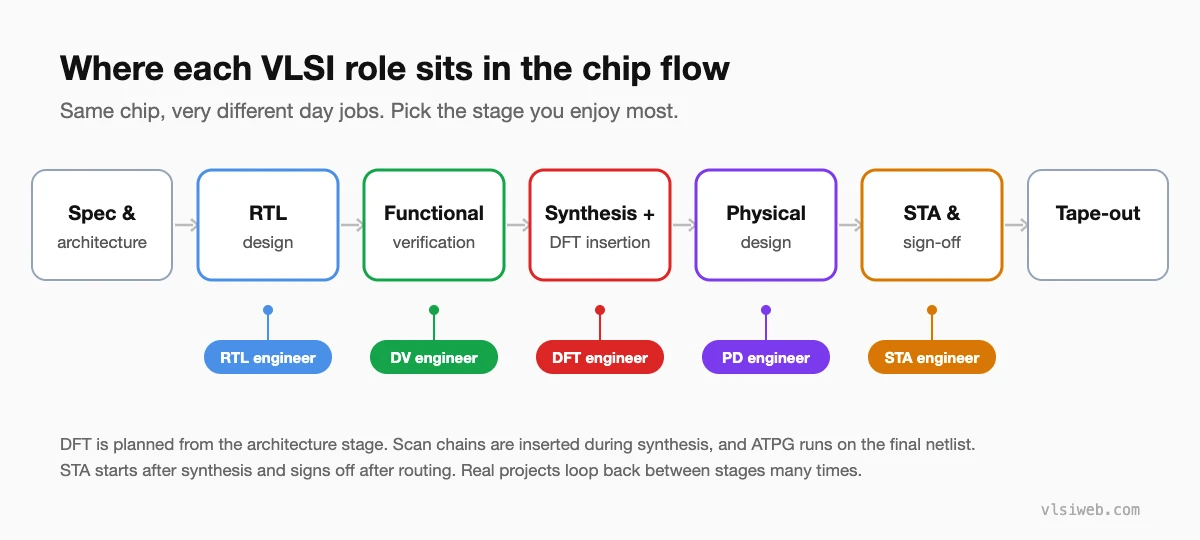
In practice, you insert scan chains during synthesis so the tester can control and observe internal flops, add compression so the test fits in a short time, add MBIST controllers for memories, generate ATPG patterns on the final netlist, and simulate them to make sure they work. After silicon comes back, you help debug test failures with the test and product engineers.
Part 2: A typical week
A typical week in DFT looks something like this:
- Planning test architecture for a new block or chip
- Inserting scan and compression, and checking DFT design rules
- Running ATPG and working to improve fault coverage
- Adding and verifying MBIST for memories
- Simulating test patterns on the gate-level netlist and debugging mismatches
- Working with PD and STA on test-mode timing
Part 3: The skills you need
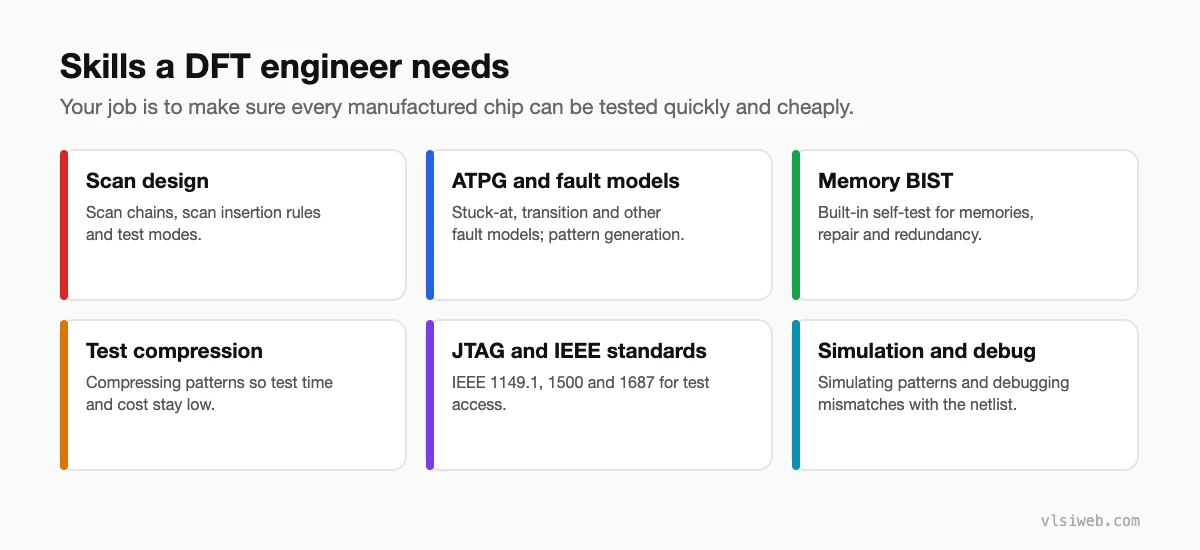
The first thing I would get solid on is fault models: what a stuck-at fault and a transition fault actually are, and why coverage numbers matter to product cost and quality.
After that, it is about understanding how scan changes the design. Scan affects timing, power and routing, so a good DFT engineer talks to the design, PD and STA teams all the time.
Part 4: Tools you will use
Common tools include Siemens Tessent, Synopsys TestMAX and DFT Compiler, and Cadence Modus, along with simulators for pattern verification. These are commercial tools, so most people learn them on the job. You can still learn the concepts at home by building scan chains and simple BIST logic in Verilog and simulating them.
Part 5: How I would get started
- Learn digital fundamentals and synthesis basics.
- Study fault models (stuck-at, transition) and what fault coverage means.
- Build a small design with a scan chain in Verilog and shift patterns through it in simulation.
- Write a simple memory BIST (a March algorithm) for a small RAM.
- Read the basics of IEEE 1149.1 (JTAG) and how test access works on a chip.
Practise this on VLSI Forge
I built VLSI Forge so you can write RTL in your browser, run it on a real simulator and check every signal in the waveform. Free, nothing to install.
Part 6: Where the role leads
DFT engineers grow from inserting and verifying test logic on blocks, to owning the DFT architecture for a full chip. Senior DFT engineers often work closely with test and product engineering on yield and silicon debug.
Because DFT touches design, timing and manufacturing, it is also a good base for moving into silicon validation, product engineering or architecture later.
FAQ
Is DFT a good career choice?
Yes. Every chip needs DFT, fewer engineers specialise in it, and good DFT engineers are hard to find. It is a stable and well-respected role.
Do DFT engineers need to know RTL?
You should be able to read and write RTL comfortably, especially for things like test control logic and BIST. Most DFT work happens on the netlist, though.
What is the difference between DFT and post-silicon validation?
DFT designs the test logic and patterns before tape-out. Post-silicon validation checks that real chips behave correctly after they come back from the fab.
Can freshers get DFT jobs?
Yes, though there are fewer openings than in verification or PD. Showing that you understand scan, ATPG basics and fault models helps a lot.
