
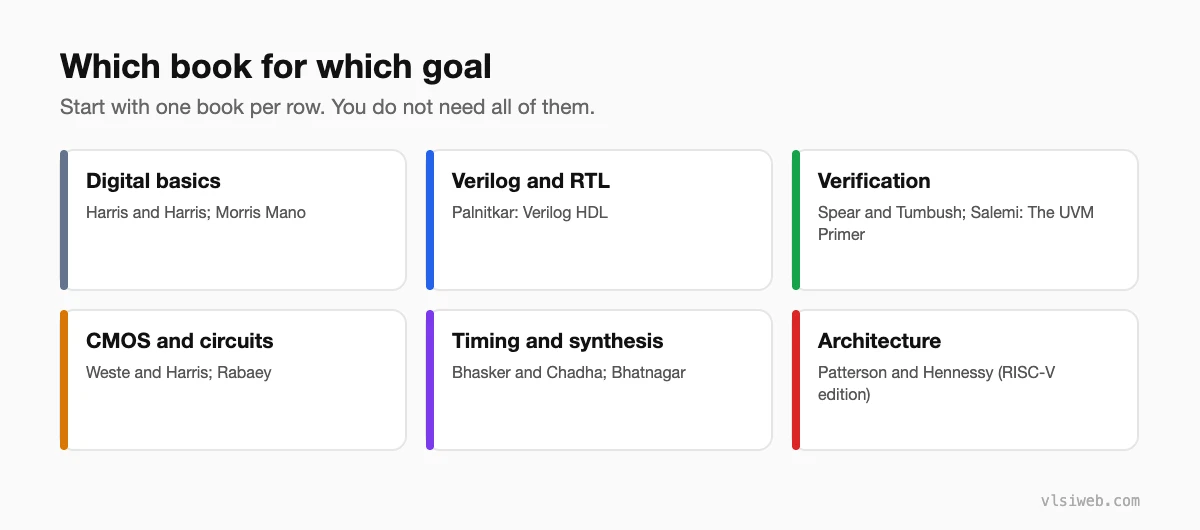
The short answer: you only need a handful of books. For digital basics, Harris and Harris; for Verilog, Palnitkar; for verification, Spear and Tumbush plus The UVM Primer; for circuits, Weste and Harris; for timing, Bhasker and Chadha; and for architecture, Patterson and Hennessy. Read the one that matches your next goal, not all of them at once.
Book lists online tend to name thirty titles, which nobody reads. I would rather give you a short list, grouped by what you are trying to learn, with a note on when each one is worth your time.
- Which book for which goal
- Digital design basics
- Verilog and RTL design
- Verification
- CMOS, circuits and physical design
- Timing, synthesis and test
- Computer architecture
Table of Contents
Part 1: Which book for which goal
Part 2: Digital design basics
- Digital Design and Computer Architecture by David Harris and Sarah Harris: my first pick. Clear, modern, and it takes you from logic gates to a working processor.
- Digital Design by M. Morris Mano: a classic many Indian universities use. Good for fundamentals and exam-style practice.
Part 3: Verilog and RTL design
- Verilog HDL by Samir Palnitkar: a long-time favourite for learning the language properly.
- Pair it with daily coding practice. A language book on its own will not make you fluent.
Part 4: Verification
- SystemVerilog for Verification by Chris Spear and Greg Tumbush: the standard introduction to classes, randomisation and coverage.
- The UVM Primer by Ray Salemi: a short, friendly introduction to UVM concepts.
- Writing Testbenches using SystemVerilog by Janick Bergeron: deeper thinking about verification strategy.
Part 5: CMOS, circuits and physical design
- CMOS VLSI Design by Neil Weste and David Harris: the go-to book for how chips are built at the transistor and layout level.
- Digital Integrated Circuits by Jan Rabaey and co-authors: another excellent circuit-level text.
- Design of Analog CMOS Integrated Circuits by Behzad Razavi: essential if you are heading into analog.
Part 6: Timing, synthesis and test
- Static Timing Analysis for Nanometer Designs by J. Bhasker and Rakesh Chadha: the standard STA reference.
- Advanced ASIC Chip Synthesis by Himanshu Bhatnagar: practical synthesis concepts.
- VLSI Test Principles and Architectures edited by Laung-Terng Wang and others: a thorough DFT reference.
Part 7: Computer architecture
- Computer Organization and Design (RISC-V Edition) by David Patterson and John Hennessy: the best starting point for CPU design.
- Computer Architecture: A Quantitative Approach by John Hennessy and David Patterson: the deeper follow-up once you are comfortable.
Practise this on VLSI Forge
I built VLSI Forge so you can write RTL in your browser, run it on a real simulator and check every signal in the waveform. Free, nothing to install.
A book you finish and practise from is worth ten you only skim. Pick the one that matches your next step, and code along as you read.
FAQ
Which one book should a beginner start with?
Digital Design and Computer Architecture by Harris and Harris. It covers fundamentals, HDLs and a full processor in one place.
Are books still useful when there are so many videos?
Yes. Good books are more complete and more accurate than most videos, and they are much better for reference later.
Do I need to read all these books?
No. Read the ones that match the role you are aiming for, and use the rest as references when you need them.
Are newer editions worth buying?
For architecture and verification, newer editions are usually worth it. For digital basics, an older edition is often fine.
