

The short answer: you can learn most of VLSI for free. My suggested path is: digital design lectures from NPTEL or MIT OpenCourseWare, daily Verilog practice on HDLBits, SystemVerilog and UVM from ChipVerify and Siemens Verification Academy, then a real RTL-to-layout flow with open-source tools, and finally a tiny chip of your own through Tiny Tapeout.
Paid courses can be useful, but you do not need one to get started. Some of the best material on chip design is free, made by universities, tool companies and the open-source hardware community. The hard part is knowing what to use, and in what order. Here is the path I would follow.
- The free study path
- Digital design and CMOS basics
- Verilog practice
- SystemVerilog, UVM and verification
- Real tools and a real chip
Table of Contents
Part 1: The free study path
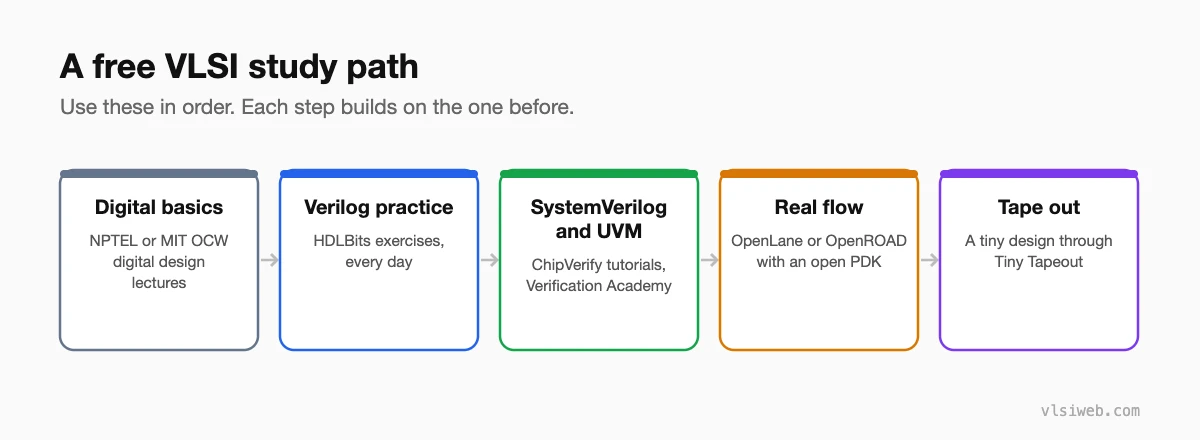
The order matters more than the exact courses. Fundamentals first, then lots of practice, then real tools. Most people skip step 2 and go straight to watching UVM videos, and then struggle in interviews.
Part 2: Digital design and CMOS basics
- NPTEL: free courses from IIT and IISc professors on digital circuits, VLSI design, CMOS and computer architecture. Pick one digital design course and finish it properly.
- MIT OpenCourseWare: lectures and labs on digital systems and computation structures, if you like a more hands-on style.
I would pick one course and finish it, rather than starting five.
Part 3: Verilog practice
- HDLBits: short Verilog exercises with instant checking, from simple gates to FSMs. It is one of the best free tools for building fluency.
- VLSI Forge: interview-style RTL problems that run on a real simulator, with waveforms and test results. I built it for exactly this step.
Part 4: SystemVerilog, UVM and verification
- ChipVerify: clear, free tutorials on Verilog, SystemVerilog and UVM, with examples.
- Siemens Verification Academy: free courses on UVM, assertions and coverage (free registration needed).
Part 5: Real tools and a real chip
- OpenROAD and OpenLane: open-source RTL-to-GDS flows that let you take a design through synthesis, placement, routing and checks with an open PDK like SKY130.
- Tiny Tapeout: a community project that lets you put a small design on a real shared chip for a low cost, with free learning material along the way.
Seeing your own design as layout, or even as silicon, changes how you think about RTL.
Practise this on VLSI Forge
I built VLSI Forge so you can write RTL in your browser, run it on a real simulator and check every signal in the waveform. Free, nothing to install.
Free RTL practice problems · Free course previews
Free resources work best with a plan and a habit. An hour a day on this path will take you further than any course you only half finish.
FAQ
Are free VLSI courses enough to get a job?
They can be, if you combine them with real projects and lots of practice. Employers care about what you can do and explain, not where you learned it.
Is NPTEL certification useful?
It shows commitment and can help a little on a fresher resume, but projects and interview performance matter far more.
Do I need paid EDA tools to learn?
No. Verilator, Icarus Verilog, Yosys and OpenROAD let you learn the full flow for free.
Should I join a paid VLSI training institute?
Only after checking it carefully: who teaches, what projects you build, and real placement data. Never pay for a promise of a guaranteed job.
