

The short answer: an RTL synthesis engineer turns RTL code into a gate-level netlist using a library of standard cells, while meeting the targets for timing, power and area. You own the synthesis flow and constraints, check that the netlist is logically equivalent to the RTL, and give designers and PD engineers early feedback on timing and power.
Synthesis is the bridge between front-end design and back-end implementation. In many companies it is a dedicated role; in others, designers or PD engineers run it themselves. Either way, the skills are valuable. Here is what the work involves.
- What a synthesis engineer actually does
- A typical week
- The skills you need
- Tools you will use
- How I would get started
- Where the role leads
Table of Contents
Part 1: What a synthesis engineer actually does
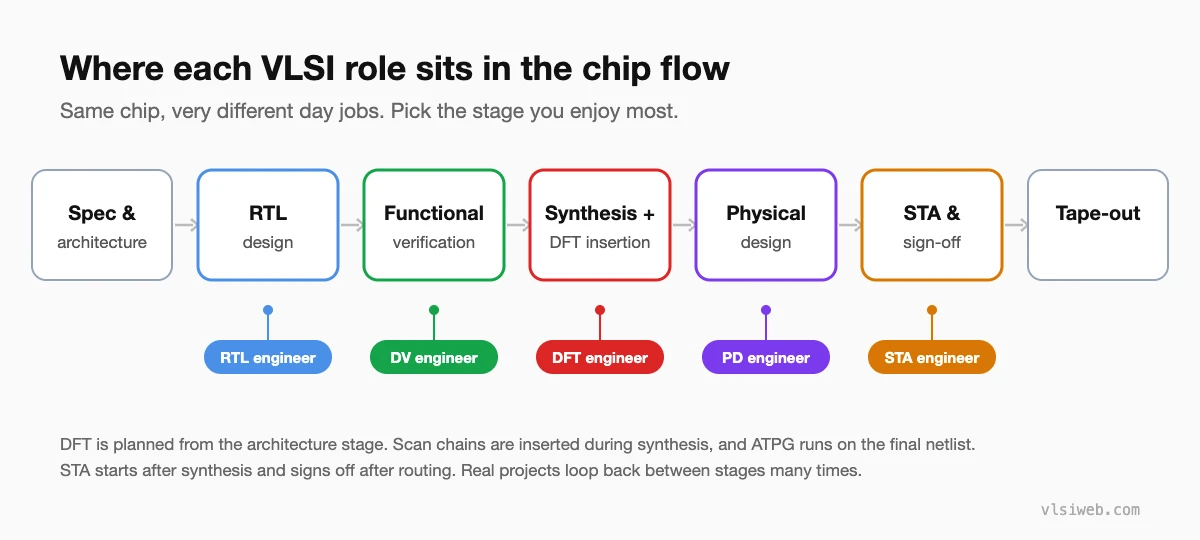
A synthesis engineer takes the RTL, the timing constraints and the standard-cell libraries, and produces a netlist the PD team can place and route. You tune the flow to hit the targets, which means choosing optimisation settings, handling clock gating and power intent, and making sure DFT logic is inserted correctly.
You also check quality: equivalence checking proves the netlist does the same thing as the RTL, and early timing and area reports tell designers where their RTL needs work, long before PD starts.
Part 2: A typical week
A typical week in synthesis looks something like this:
- Running synthesis on new RTL drops and checking for errors and warnings
- Reviewing timing and area reports and feeding issues back to designers
- Updating constraints and power intent as the design changes
- Running equivalence checks between RTL and netlist
- Working with DFT on scan and compression insertion
- Comparing results across settings or tool versions with scripts
Part 3: The skills you need
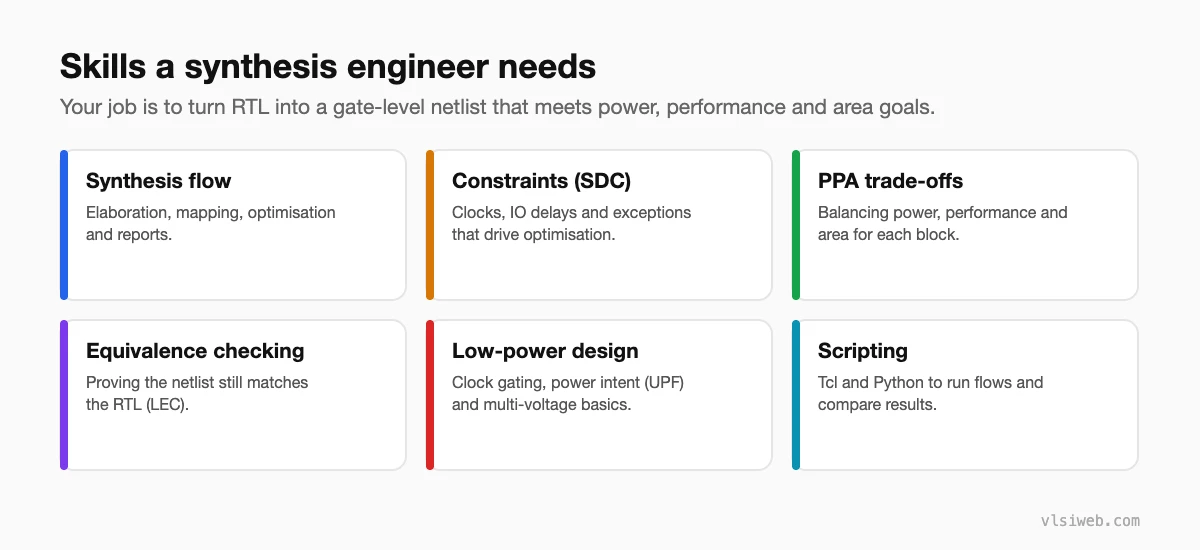
The thing I would understand first is how RTL coding style turns into hardware. Synthesis engineers spend a lot of time explaining to designers why a piece of code produced a slow or large circuit, and how to rewrite it.
Constraints are the other big skill. The tool optimises exactly what the constraints tell it to, so a wrong constraint gives you a netlist that looks fine but fails later.
Part 4: Tools you will use
Common tools include Synopsys Design Compiler and Fusion Compiler, Cadence Genus, and equivalence checkers like Cadence Conformal or Synopsys Formality. At home, Yosys is an excellent free synthesis tool for learning how RTL maps to gates.
Part 5: How I would get started
- Learn digital fundamentals and STA basics.
- Write small RTL designs and synthesise them with Yosys to see the gates they produce.
- Learn SDC basics: clocks, input and output delays, false paths.
- Study how coding style affects area and timing: case statements, resets, resource sharing.
- Learn the basics of clock gating and power intent (UPF).
Practise this on VLSI Forge
I built VLSI Forge so you can write RTL in your browser, run it on a real simulator and check every signal in the waveform. Free, nothing to install.
Part 6: Where the role leads
Synthesis engineers often grow into implementation leads who own the whole RTL-to-GDS flow, or into methodology roles that build flows for the whole company. Many also move into STA or physical design, since the skills overlap.
Synthesis experience is also very valued at EDA companies, in application engineering and tool development.
FAQ
Is synthesis a separate job?
In large companies, often yes. In smaller teams, designers or PD engineers run synthesis. Either way, understanding synthesis makes you better in both roles.
Do I need to know RTL for synthesis?
Yes. You need to read RTL well enough to explain why a piece of code synthesises badly and suggest a better way to write it.
What is equivalence checking?
A formal check that proves the gate-level netlist behaves exactly like the RTL, so nothing was broken by optimisation or test insertion.
Is low-power knowledge important?
Increasingly, yes. Clock gating, power domains and UPF are now part of almost every synthesis flow.
