


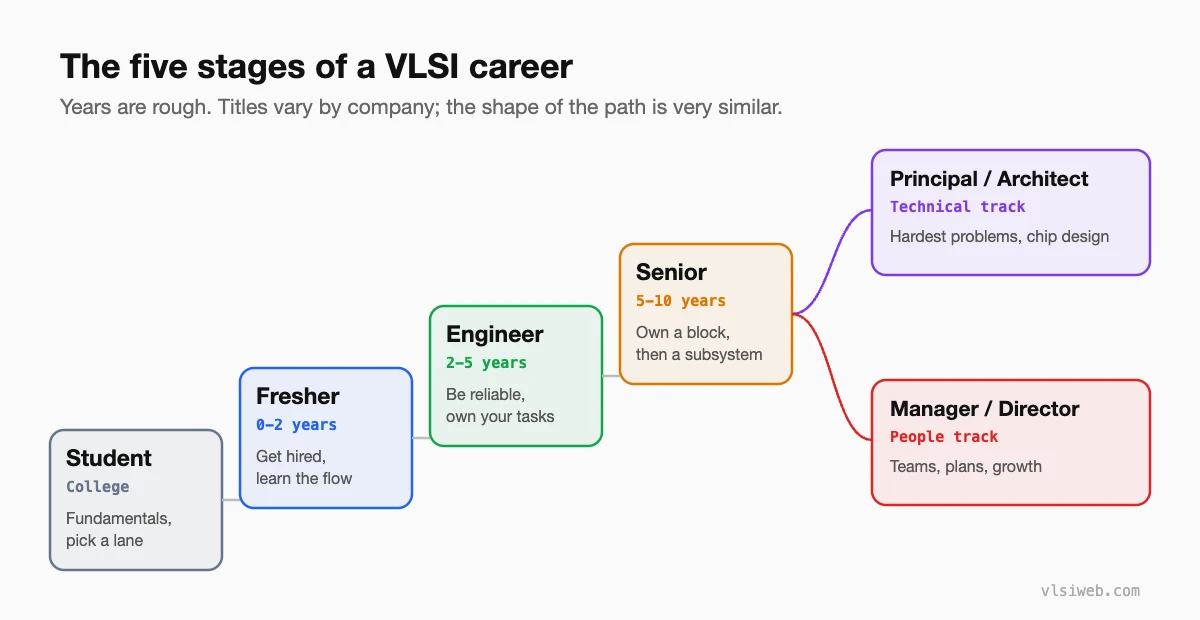
The short answer: a VLSI career usually moves through five stages: student, fresher, engineer, senior engineer, and then a choice between going deeper technically (principal, architect) or leading people (manager). Each stage has one main job. As a student, learn the fundamentals and pick a lane. As a fresher, get reliable at the basics of that lane. After that, it’s about owning bigger pieces of the chip and making the people around you better.
Most VLSI roadmaps I see stop at “get your first job”. I think that’s the wrong place to stop. The first job matters, but what you do in years two to five decides most of how your career goes. So in this roadmap I’ll walk through the whole thing, from your college years to the senior roles, and tell you what I’d focus on at each step.
If you only want to know what to learn to get hired, read my guide to the VLSI skills that actually get you hired first. This post is about the bigger picture.
Here’s what I’ll cover:
- The five stages of a VLSI career
- Stage 1: Student – pick a lane and build the base
- Stage 2: Fresher – get hired
- Stage 3: Engineer – become the person people trust
- Stage 4: Senior – own a block, then a subsystem
- Stage 5: Principal, architect or manager
- Mistakes I’d avoid at every stage
Table of Contents
Part 1: The five stages of a VLSI career
Job titles differ from company to company, and the years below are rough. Some people move faster, some slower, and that’s fine. But the shape of the journey is very similar everywhere.
Part 2: Stage 1 – Student: pick a lane and build the base
Your only two goals in college are strong digital fundamentals and a clear idea of which part of chip design you want to do. Everything else can wait.
Who usually gets into VLSI
Most VLSI engineers come from ECE, EEE or instrumentation, or did an M.Tech in VLSI or microelectronics. CSE students with a real interest in hardware do well too, especially in verification, where strong programming helps a lot.
What I’d learn first
- Digital design: Boolean logic, combinational and sequential circuits, FSMs, setup and hold time, metastability
- CMOS basics: how a MOSFET switches, CMOS logic, and where power goes
- Verilog: synthesisable RTL, testbenches, and reading waveforms
- The chip flow: spec → RTL → verification → synthesis and DFT → physical design → STA and sign-off → tape-out. Even if you only work on one stage, you should know what happens in the others.
How I’d pick a lane
Don’t pick based on what your friends are doing or which role you heard pays most. Pick based on the kind of problem you enjoy, because you’ll be solving it every day for years.
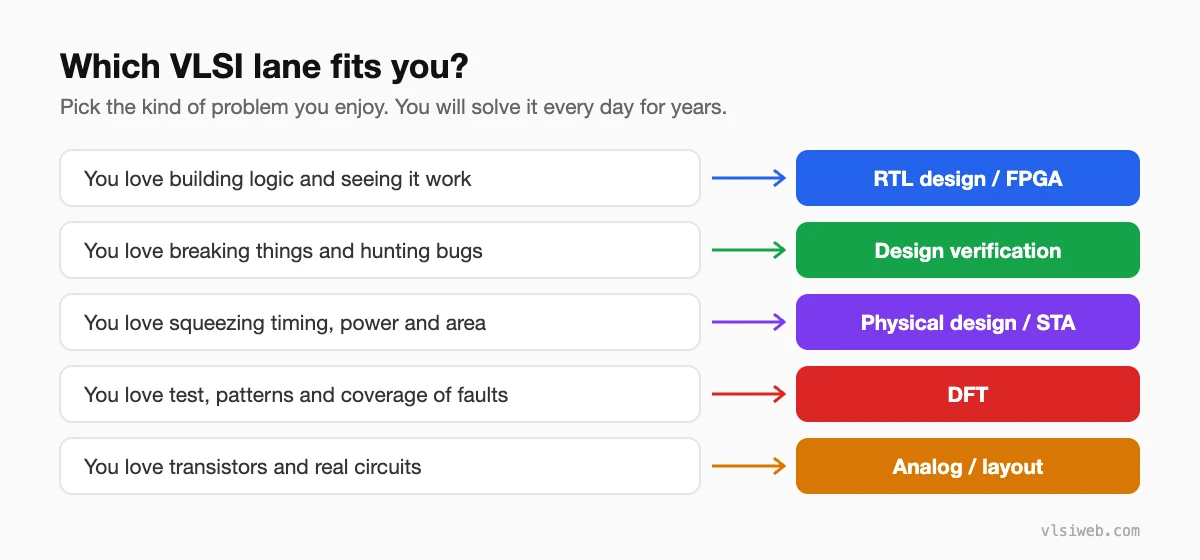
Try small projects in two lanes before you decide. A UART in Verilog and a simple testbench for it will tell you more about whether you like design or verification than any article.
Part 3: Stage 2 – Fresher: get hired
This is the stage everyone worries about most. My advice is to stop trying to look impressive and start trying to look reliable. A hiring manager taking on a fresher is asking one question: “If I give this person a small task, will they get it right and ask good questions when they’re stuck?”
- Have two projects you can explain deeply. One small and polished, one bigger. Put them on GitHub with a README, a block diagram and a waveform.
- Keep your resume to one page. Skills, projects and links. Leave out unrelated subjects and long lists of tools.
- Apply widely. Product companies, design service companies, startups and FPGA companies all hire freshers. Service companies are a very common and very good first step, because you see many projects quickly.
- Practise out loud. Interviews are spoken. If you can’t explain a two-flop synchroniser to a friend, you can’t explain it to an interviewer.
And please don’t panic if it takes a few months. Very few people get the first job they apply for, and every interview makes the next one easier.
Part 4: Stage 3 – Engineer (around 2–5 years): become the person people trust
Once you’re in, the goal changes. Now it’s about becoming dependable: the engineer whose work doesn’t need to be checked twice.
- Finish things. A block that’s 100% done is worth more than three that are 90% done.
- Learn the “why”, not just the “how”. Why does this block have this many pipeline stages? Why is this constraint here? People who ask why grow much faster.
- Automate your own work. Python and Tcl scripts that save your team an hour a week get noticed.
- Write things down. Short notes on bugs you found and how you fixed them. They’ll help you in reviews, and they’ll help you in interviews later.
This is also when many people consider switching lanes, for example from verification to design, or from PD to STA. It’s very doable at this stage, because you already understand how the flow fits together.
Part 5: Stage 4 – Senior (around 5–10 years): own a block, then a subsystem
The jump to senior isn’t about knowing more commands. It’s about ownership. A senior engineer owns a block or a subsystem from start to finish: planning, schedule, reviews, and making sure it actually works on silicon.
- You review other people’s work and catch problems early.
- You talk to the teams around you: architecture, software, PD, test.
- You start thinking about trade-offs (power, performance, area, schedule), not just correctness.
- You help juniors. Teaching is one of the fastest ways to find the gaps in your own understanding.
Part 6: Stage 5 – Principal, architect or manager
Around here the path splits, and both directions are good.
- Technical track (principal engineer, architect): you go deep. You define how a chip or subsystem should work, solve the hardest technical problems, and set methodology for the team.
- People track (manager, director): you go wide. You build and grow teams, plan projects, and make sure the right people are working on the right things.
Neither is “higher” than the other in a good company. I’d choose based on what gives you energy: solving hard problems yourself, or helping a team solve them.
Practise this on VLSI Forge
Whatever stage you’re at, the fundamentals never stop mattering. I built VLSI Forge so you can write RTL in your browser, run it on a real simulator and check every signal in the waveform. Free, nothing to install.
Browse all problems · Guided courses
Part 7: Mistakes I’d avoid at every stage
- Chasing tools instead of concepts. Tools change; setup and hold time don’t.
- Staying in one comfortable task too long. If you’ve done the same thing for two years and stopped learning, ask for something new.
- Ignoring communication. Clear emails, clear bug reports and clear reviews matter more every year you grow.
- Comparing your timeline with others. Careers aren’t a race. The person who understands things deeply usually catches up and overtakes.
If you take one thing from this roadmap, let it be this: at every stage, the people who grow fastest are the ones who understand the fundamentals deeply and keep asking why. Everything else follows from that.
FAQ
How long does it take to become a senior VLSI engineer?
Typically somewhere around five to eight years, but it depends far more on the scope of work you’ve owned than on the years themselves. Owning a block end to end, including silicon bring-up, speeds things up a lot.
Is it better to start at a service company or a product company?
Both are good starts. Service companies expose you to many projects and tools quickly. Product companies let you go deep on one chip and see it through to silicon. I’d take whichever offer gives you the most real hands-on work.
Can I switch from one VLSI role to another later?
Yes, and many people do. Switches between neighbouring roles, like verification to design or physical design to STA, are the easiest. The two to five year stage is usually the best time to do it.
Do I need an M.Tech to grow in VLSI?
No. An M.Tech can help you get into some product companies straight out of college, but after a few years your work experience matters much more than your degree.
