

The short answer: most VLSI jobs come from five places: company career pages, LinkedIn, referrals, campus and job portals like Naukri, and design service companies that hire in batches. The people who find jobs fastest don’t just apply more. They search with the right keywords, ask for referrals well, and follow up. A simple weekly routine beats random bursts of applications.
If you look at how people actually get their VLSI jobs, it’s rarely the “Easy Apply” button. It’s usually a mix of a well-targeted application, a referral, and good timing. In this guide I’ll show you where to look and how I’d run the search, step by step.
- Where VLSI jobs are posted
- Search with the right keywords
- Referrals: the fastest route in
- A weekly routine that works
- Red flags to avoid
Table of Contents
Part 1: Where VLSI jobs are posted
- Company career pages. Every semiconductor and EDA company posts roles on its own site first. Make a list of 20 to 30 companies you’d like to work for and check their pages every week, or set up job alerts where they offer them.
- LinkedIn Jobs. The biggest single source for experienced roles, and useful for freshers too. Turn on alerts for your exact role and city.
- Naukri, Indeed and similar portals. Especially useful in India for design service companies, which often hire through recruiters and portals.
- Design service companies. They work on chips for many clients and hire freshers and experienced engineers in batches. They’re one of the most common first jobs in VLSI.
- Startups. Many chip startups post only on LinkedIn or their own site, and some hire mainly through referrals. Follow their founders and engineers.
- Campus placements. If you’re still in college, this is often the easiest route, so prepare well for the companies that visit.
Part 2: Search with the right keywords
Searching for just “VLSI” gives you a lot of noise, including training institutes and unrelated roles. Companies rarely use the word in job titles. Use the titles they actually post:
| Your lane | Search for |
|---|---|
| RTL design | RTL design engineer, ASIC design engineer, digital design engineer, logic design |
| Verification | Design verification engineer, ASIC verification, SoC verification, UVM |
| Physical design | Physical design engineer, PnR, place and route, timing closure |
| STA | STA engineer, static timing analysis, timing sign-off |
| DFT | DFT engineer, design for test, ATPG, scan, MBIST |
| FPGA | FPGA design engineer, FPGA developer, RTL FPGA |
Add “graduate”, “new grad”, “fresher” or “0-2 years” if you’re early in your career, and add your city.
Part 3: Referrals: the fastest route in
A referral doesn’t guarantee a job, but it often gets a human to actually read your resume, which is half the battle. Here’s how I’d ask:
- Find someone at the company who does the role you want. Seniors from your college are the easiest start.
- Send a short, specific message: who you are, the exact job link or ID, and one line on why you fit.
- Attach or link your resume, so they don’t have to ask.
- Thank them, whatever happens, and tell them how it went.
What I’d avoid: long life stories, “please refer me for any role”, or messaging fifty people at the same company on the same day.
Part 4: A weekly routine that works
Job searching is tiring, and it’s easy to apply to thirty roles in one night and then nothing for two weeks. A steady routine works better.
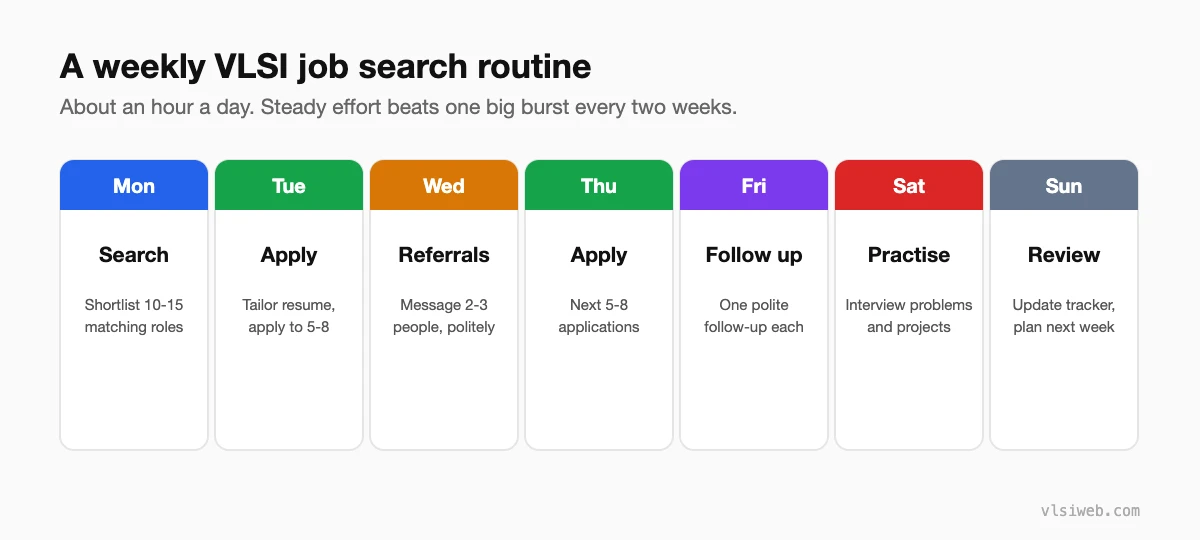
- Keep a tracker. A simple sheet with company, role, link, date applied, referral, and status. You’ll be surprised how quickly you lose track without one.
- Tailor a little. Move the most relevant project to the top of your resume for each role. Five minutes per application is enough.
- Follow up once. If you hear nothing after a week or two, one polite message to the recruiter or your referrer is fine.
- Keep practising. Interviews can come with a day’s notice. Keep solving problems while you apply.
Practise this on VLSI Forge
Keep your skills sharp while you search. I built VLSI Forge so you can solve interview-style RTL, verification, CDC and STA problems in your browser, with a real simulator and waveforms. Free, nothing to install.
Part 5: Red flags to avoid
- Paying for a job. A real employer never asks you to pay a fee for an interview, an offer or a “placement”. Training institutes that promise jobs are selling a course, not a job.
- Offers without an interview. If someone offers you a VLSI role without any technical interview, be very careful.
- Personal details too early. Don’t share ID documents or bank details until you have a signed offer from a company you’ve verified.
- Vague job descriptions. “VLSI engineer, any skills, immediate joining” is usually not a real design role.
If something feels off, check the company’s official website and LinkedIn page, and ask people who work there. Real companies are easy to verify.
FAQ
Which is the best job portal for VLSI jobs in India?
There isn’t one best portal. LinkedIn and company career pages are best for product companies, and Naukri works well for design service companies. I’d use all three, plus referrals.
How many jobs should I apply to each week?
Quality matters more than numbers. Ten to fifteen well-matched applications a week, with a couple of referral requests, is a good pace for most people.
Should I message recruiters directly?
Yes, if it’s short and specific. Mention the exact role, your strongest matching skill and a link to your resume. Don’t send the same message to every recruiter you can find.
How long does a VLSI job search usually take?
For freshers it often takes a few months; for experienced engineers it can be faster. It depends a lot on hiring cycles, so don’t judge yourself by the first few weeks.
