

The short answer: FPGA-based prototyping means running an ASIC design on one or more FPGAs before the chip is manufactured. It runs far faster than simulation, fast enough to boot firmware and an operating system and to connect real interfaces, so software teams can start early and system-level bugs are found before tape-out.
Simulation is great for finding bugs in a block, but it is far too slow to boot Linux on a whole SoC. That is where FPGA prototyping comes in. The old version of this page was over 5,000 words; here is what you actually need to know.
- The prototyping flow
- Why teams prototype on FPGAs
- What has to change in the design
- Prototyping vs emulation vs simulation
- Skills you need for prototyping work
Table of Contents
Part 1: The prototyping flow
Part 2: Why teams prototype on FPGAs
- Speed: prototypes typically run many orders of magnitude faster than RTL simulation, fast enough for real software.
- Early software: firmware and driver teams can start months before silicon.
- Real interfaces: connect real cameras, displays, networks and sensors.
- System bugs: some bugs only appear after billions of cycles or with real software, and prototypes find them before tape-out.
Part 3: What has to change in the design
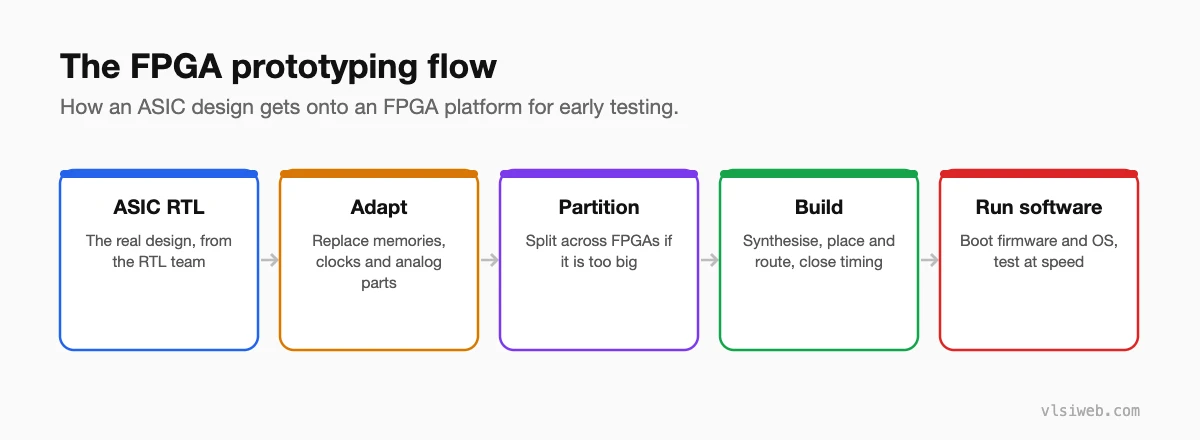
- Memories: ASIC memory macros are replaced with FPGA block RAM or external memory.
- Clocks: high ASIC clock frequencies are scaled down, and clock trees are mapped to FPGA clock resources.
- Analog and IO: PLLs, PHYs and analog blocks are replaced with FPGA equivalents or daughter cards.
- Partitioning: big SoCs do not fit in one FPGA, so they are split across several, with careful handling of the signals between them.
Part 4: Prototyping vs emulation vs simulation
| Method | Speed | Debug visibility | Best for |
|---|---|---|---|
| Simulation | Slowest | Full | Block-level bugs |
| Emulation | Fast | Very good | Large designs, hardware-software debug |
| FPGA prototyping | Fastest | Limited | Software development, real interfaces |
Large companies often use all three at different stages.
Part 5: Skills you need for prototyping work
- Strong RTL and FPGA knowledge: synthesis, timing closure, clocking.
- Comfort with lab equipment and board bring-up.
- Understanding of the SoC: buses, memory maps, interrupts.
- Enough software knowledge to help bring up firmware.
Practise this on VLSI Forge
I built VLSI Forge so you can write RTL in your browser, run it on a real simulator and check every signal in the waveform. Free, nothing to install.
FPGA Design problems · Build a RISC-V CPU
FAQ
What is the difference between emulation and FPGA prototyping?
Emulators are specialised systems with much better debug visibility and faster compile times; FPGA prototypes usually run faster and cost less, but are harder to debug.
Do I need a big FPGA board to learn prototyping?
No. You can learn the ideas by putting a small CPU or SoC design on a low-cost board and booting simple software on it.
Is FPGA prototyping a separate job?
In large companies, yes: there are dedicated prototyping and emulation teams. In smaller teams, FPGA or design engineers do it.
What tools are used?
FPGA vendor tools like Vivado and Quartus, plus commercial prototyping platforms and partitioning software from EDA vendors.
