


The short answer: the best way to land a VLSI internship is to apply early (many companies hire interns six to nine months ahead), apply widely (product companies, design service companies, startups and research labs), and show one or two real projects you can explain in depth. A good internship often turns into your first job offer, so it’s worth preparing for properly.
Internships are the single best shortcut into this industry. You see how real chip teams work, you get a real project on your resume, and a lot of companies use their intern programmes to pick who they hire as freshers. In this guide I’ll explain how I’d go about getting one.
- When to start looking
- Where VLSI internships actually come from
- What companies look for in an intern
- How to apply so you get noticed
- How to prepare for the interview
- How to turn the internship into a job offer
Table of Contents
Part 1: When to start looking
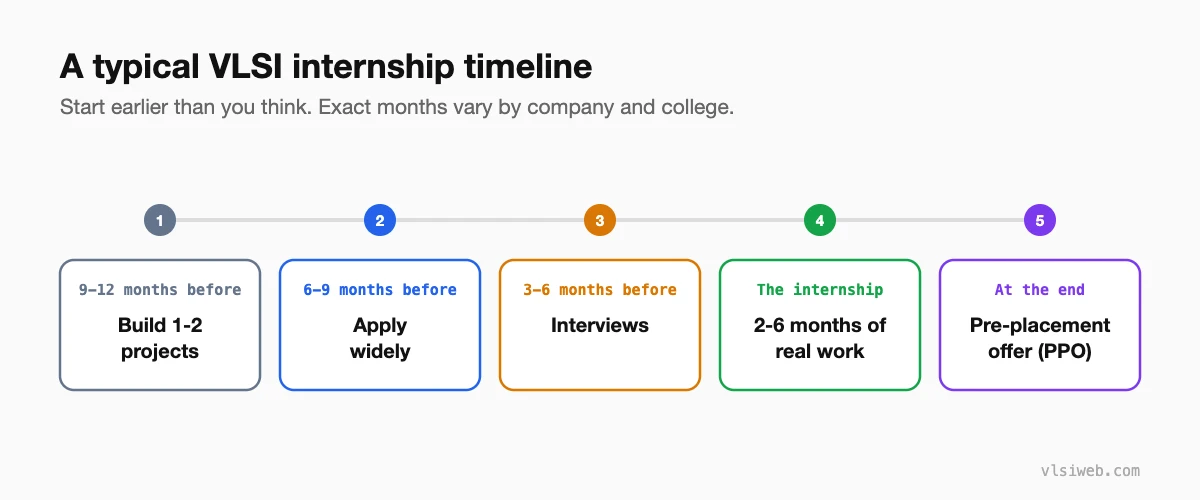
Start earlier than you think. Large companies often open intern roles six to nine months before the internship starts, and the good ones fill quickly. If you want a summer or final-semester internship, I’d begin applying in the second half of the year before.
Part 2: Where VLSI internships actually come from
- Your college placement cell. For many students this is still the biggest source. Check which semiconductor companies visit your campus and what they asked previous batches.
- Company career pages. Big product and design companies post intern roles on their own career sites. Set alerts for “intern” or “student” roles in design, verification, physical design and DFT.
- LinkedIn and job portals. Useful for design service companies and startups, which often hire interns with shorter notice.
- Startups. Smaller teams mean you touch more of the flow. The work is often more hands-on than at a big company.
- Professors and research labs. University and research-lab projects in chip design, FPGA or RISC-V count as real experience, and they often lead to industry contacts.
- Government-backed programmes. In India, schemes under the India Semiconductor Mission and MeitY’s Chips to Startup programme have funded chip design training and projects at many institutes. Ask your department whether yours takes part.
Part 3: What companies look for in an intern
Nobody expects an intern to know everything. In my view the bar is simpler than most students think:
- Solid digital basics. Flip-flops, FSMs, setup and hold, counters, FIFOs.
- Working Verilog. You can write a small synthesisable design and a testbench for it.
- One or two projects you understand deeply. Depth beats a long list.
- Some scripting. Basic Python or shell is a real plus.
- Curiosity and clear communication. Can you explain what you did and why?
Part 4: How to apply so you get noticed
- One-page resume. Education, skills, projects with links. Put projects near the top.
- Describe projects by what you did. “Designed a UART transmitter in Verilog and verified it with a self-checking testbench covering 4 baud rates” beats “Worked on UART”.
- Link to GitHub. Each project with a README, a block diagram and a waveform screenshot.
- Apply to many places. Ten to twenty applications is normal. Don’t take silence personally.
- Ask for referrals politely. A short, specific message to a senior from your college works far better than a generic “please refer me”.
Part 5: How to prepare for the interview
Intern interviews usually cover three things: digital fundamentals, Verilog, and your projects. I’d prepare in that order.
- Practise drawing timing diagrams for counters, shift registers and simple FSMs.
- Write small modules from memory: a mux, a counter, an edge detector, a synchronous FIFO.
- For every project, be ready for “what was the hardest bug?” and “what would you do differently?”
- Explain answers out loud while you practise. Interviews are spoken, not written.
Practise this on VLSI Forge
I built VLSI Forge for exactly this kind of preparation. Write the modules interviewers ask for, run them on a real simulator and check every signal in the waveform. Free, nothing to install.
RTL Design problems · Design Verification problems · Build a RISC-V CPU
Part 6: How to turn the internship into a job offer
Many companies make pre-placement offers (PPOs) to their best interns. Here’s what I’d do to be one of them:
- Finish your project properly. A small project that’s fully done and documented beats a big one left half-way.
- Ask good questions, then try first. Spend some time on a problem before asking, and come with what you’ve already tried.
- Give short updates. A two-line status message every few days makes your mentor’s life easy.
- End with a clear handover. A short document and a demo of what you built. It’s the last thing people remember.
- Say you’d like to return. Let your manager know, before you leave, that you’d love a full-time role.
FAQ
Are VLSI internships paid?
Most internships at established semiconductor and design service companies are paid. Amounts vary a lot by company and city. Be careful with “internships” that ask you to pay a fee; those are usually training courses, not internships.
Can I get a VLSI internship in my second or third year?
Yes, though it’s harder than in the final year. Research projects with professors, open-source hardware work and short startup internships are great options earlier on.
Do I need to know UVM for a verification internship?
Not usually. Solid SystemVerilog basics and a simple self-checking testbench are enough for most intern roles. Knowing the UVM basics is a bonus.
What if I don’t get an internship?
It’s not the end of the road. Build one strong project, practise interview problems, and apply for fresher roles. A well-explained project can carry an interview just as well as an internship.
